Keywords: Cover Crops, Legumes, Soil Carbon Storage and Stabilization, Roots, Biological N2-fixation.
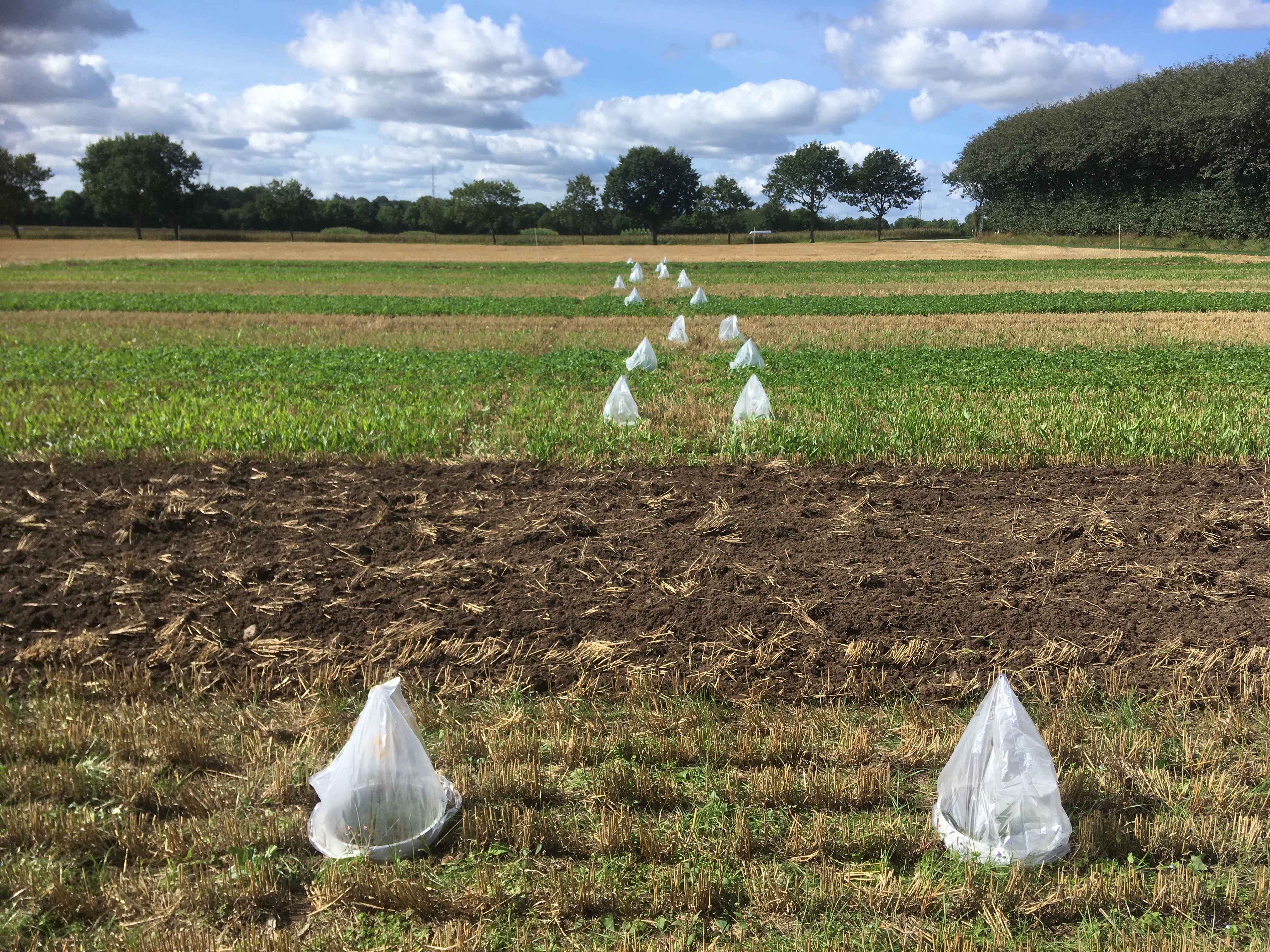
Cover crops recycle nutrients, reduce Nitrogen (N) leaching, and especially when including N2-fixing leguminous plants (e.g., clover), they can simultaneously increase N availability and soil fertility for the following crop (De Notaris et al., 2025). Depending on growth, biomass productivity, and the magnitude of belowground root carbon (C) and rhizodeposition they can also increase soil carbon storage and stability (Mortensen et al., 2021; Liang et al., 2023). In a field trial at AU Viborg, cover crop monocultures and mixtures of commonly used species (perennial ryegrass, ribwort plantain, and red clover) were grown during the autumn and winter period, with root biomass and rhizodeposition being measured in situ using advanced 13C isotopic labelling. The dataset represents a unique opportunity to investigate how various cover crop types affect soil C build up, and to assess the effects of the winter period on soil C input changes.
Is field work part of the topic (yes/no)? No
Is lab work part of the topic (yes/no)? No
Is coding part of the thesis topic (yes/no)? To the extent that statistics may be done in R.
The project is a 30 ECTS project.
Project start is flexible, suggested start is autumn 2026 or spring 2027.
The project work will take place in AU Viborg with possibilities of working remotely.
30 ECTS (IMSOGLO and Agrobiology): Theoretical thesis based on literature studies and/or analysis of issued and edited data sets.
45 ECTS (Agrobiology): Experimental theses in which the student is responsible for collection and analysis of his/her own original data
60 ECTS (Agrobiology): Experimental theses in which the student is responsible for planning, trial design and collection and analysis of his/her own original data
Suggested reading:
De Notaris C., Peixoto L., Mortensen E.Ø., Rasmussen J. (2025) Cover crop biomass production as a predictor of nitrogen fertilizer replacement value - legumes secure positive effects. Agriculture, Ecosystems & Environment 381. DOI: 10.1016/j.agee.2024.109446.
Liang Z., Rasmussen J., Poeplau C., Elsgaard L. (2023) Priming effects decrease with the quantity of cover crop residues – Potential implications for soil carbon sequestration. Soil Biology and Biochemistry 184. DOI: 10.1016/j.soilbio.2023.109110.
Mortensen E.Ø., De Notaris C., Peixoto L., Olesen J.E., Rasmussen J. (2021) Short-term cover crop carbon inputs to soil as affected by long-term cropping system management and soil fertility. Agriculture, Ecosystems & Environment 311. DOI: 10.1016/j.agee.2021.107339.


