
AGRO brought research on future food systems, soil, and biodiversity to Naturmødet 2026
From microscopic life in the soil to the future of food production, AGRO spent three days engaging with citizens, decision-makers and fellow researchers at Naturmødet in Hirtshals.

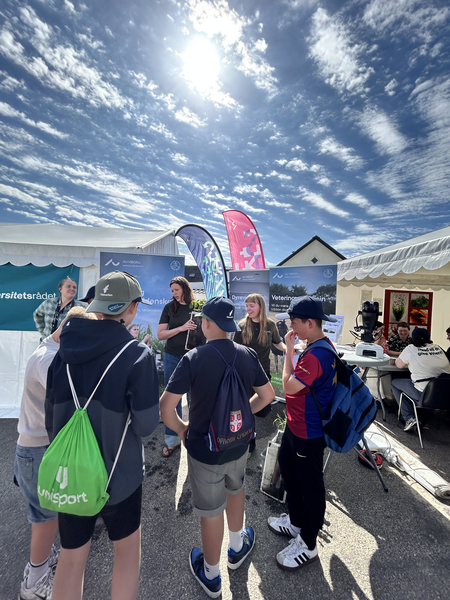
What does healthy soil actually look like? How can biodiversity be strengthened in agricultural landscapes? And how can research help shape the future of food production?
These questions formed a common thread throughout Naturmødet 2026, where researchers from the Department of Agroecology (AGRO) contributed to debates, presentations and activities across the three-day festival.
One of the recurring themes was the life hidden beneath our feet.
Mette Vestergård Madsen and Ida Junker Madsen introduced visitors to the remarkable world of soil microbiota and the billions of microorganisms that play a crucial role in nutrient cycling, plant health and ecosystem functioning. At AGRO’s stand, visitors could explore soil samples under microscopes and gain insights into a form of biodiversity that is largely invisible, yet fundamental to both agriculture and nature.
The importance of soil was also highlighted in a panel debate on soil health, where Peter Lystbæk Weber joined representatives from research, agriculture and environmental organisations. The discussion focused on the growing recognition of soil as a key resource for climate resilience, biodiversity and food production, while also addressing the challenges of defining, measuring and regulating soil health in practice.
Biodiversity in agricultural landscapes was another central topic during the festival. Through her presentation, Trine Poulsen demonstrated how advanced simulation models can be used to investigate the effects of landscape changes on biodiversity. Her research showed that even relatively small interventions can create measurable improvements, but that successful solutions depend on local conditions and careful placement within the landscape.
Agriculture's role in the green transition also featured prominently. Tommy Dalgaard participated in a debate on the Green Tripartite Agreement, discussing how collaboration across sectors can help balance environmental, economic and societal interests while supporting Denmark's transition towards a more sustainable future.
Visitors could also travel thousands of years back in time with Kim Hebelstrup, who explored the origins of agriculture and the long co-evolution between humans and plants. At the stand, guests could continue the journey through the animation Seeds of Change and displays illustrating how early crop domestication shaped the food systems we rely on today.
Future food systems attracted strong interest
Naturmødet was also an opportunity to showcase AGRO's green degree programmes in Viborg and engage visitors in conversations about future food systems.
At the Aarhus University stand, many guests were curious about plant-based foods and the role of crops such as Danish-grown soy in future food production. Discussions frequently touched on how research, innovation and education can contribute to developing more sustainable food systems in the years ahead.
Visitors also had the opportunity to meet some of the next generation of researchers. Bachelor student Thea Asser Munk presented her project investigating whether agroforestry can improve soil health through effects on earthworms and mycorrhizal fungi. Meanwhile, master's student Lærke Bruun shared insights into how shelterbelts can support biodiversity and strengthen ecological functions in agricultural landscapes.
Together, the students' contributions provided a glimpse into the research-based education offered at AGRO and the role future graduates will play in addressing some of society's most pressing challenges.
Naturmødet continues to provide a unique setting for those conversations, and AGRO was proud to be part of them once again.