
Digital knowledge networks are playing a growing role in agriculture’s green transition
Podcasts, online courses, social media, and so-called “soil influencers” have become part of the way some farmers seek knowledge about soil health and regenerative farming practices. A new study from Aarhus University and Virginia Tech shows how farmers build their own knowledge networks across traditional and emerging channels.

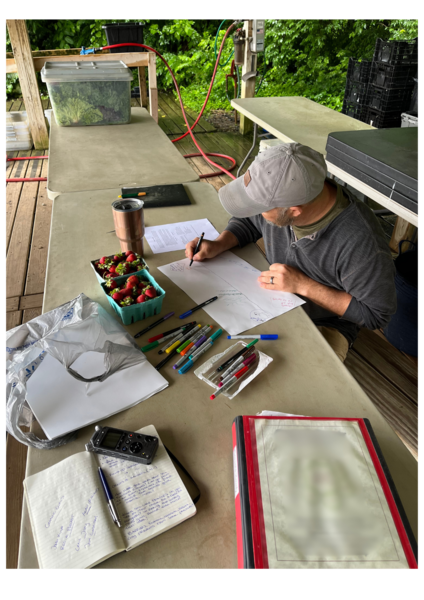
A new study from Aarhus University and Virginia Tech shows how farmers assemble their own knowledge networks across traditional and new channels.
The study, published in the scientific journal Agriculture and Human Values, examines farmers with a particular focus on soil health. In other words, farmers who deliberately prioritise the biological, physical, and ecological functioning of soil in their farming practices. This group includes, among others, farmers working with regenerative agriculture, reduced tillage, no-till, and conservation agriculture.
The results show that these farmers do not rely on a single adviser or source of knowledge. Instead, they build composite knowledge networks that include other farmers, local organisations, traditional advisory services, books, podcasts, online courses, YouTube, and social media.
The way farmers combine different sources of knowledge is central to understanding how new farming practices emerge and spread, says Kasper Krabbe, PhD at the Department of Agroecology at Aarhus University:
“If we want to understand how new farming practices emerge and spread, we need to look at where farmers actually get their knowledge. The study shows that many soil-health- and nature-oriented farmers do not learn only through conventional advisory systems, but through a much more diverse knowledge ecology of peers, courses, podcasts, social media, and digital figureheads – here, soil influencers.”
Other farmers remain central
Digital channels are playing a growing role in farmers’ learning, but the study also shows that other farmers remain among the most important and trusted sources of knowledge.
Farmers place particular value on experiences from people working under similar practical, economic, and natural conditions. Knowledge is shared through conversations, farm visits, mentoring relationships, conferences, and farmer-led organisations.
Digital platforms, however, expand the range of possible sources of inspiration. Through podcasts, videos, courses, and social media, farmers can follow experiments and farming practices far beyond their own local area.
This gives them access to experiences from farmers and communicators they would otherwise never encounter.
What is a “soil influencer”?
In the article, the researchers use the term soil influencers to describe farmers, advisers, and educators who communicate knowledge about soil health to a broad and geographically dispersed audience.
This may take place through podcasts, YouTube channels, social media, books, or digital training programmes.
The term therefore covers more than influencers in the conventional sense. The researchers describe them rather as new intermediaries in agricultural knowledge systems. They communicate both practical methods and particular ways of understanding soil and its processes.
An interesting finding is that the farmers in the study did not primarily assess these people’s credibility based on formal titles or institutional affiliation. What mattered more was their ability to demonstrate practical results and explain soil biological processes in a way that farmers found recognisable and applicable in their own everyday practice.
Digital communicators could, for example, give farmers new ways of observing soil structure, biological activity, plant development, and field resilience.
It is particularly the combination of practical experience and communication that can make these individuals relevant to farmers:
“These soil influencers are often perceived as relevant because they speak from practice. They do not appear only as experts explaining soil from the outside, but as people who have themselves tried to make cover crops, grazing, soil life, and farm economics work together on a real farm,” explains Kasper Krabbe.
Three farming conceptsRegenerative agriculture Conservation agriculture No-till farming |
Advisory services are not being replaced
The results do not mean that farmers have abandoned established advisory services.
They continued to use formal advisers and public services for purposes such as soil testing, regulatory matters, and support and conservation programmes. However, several participants felt that traditional advisory services did not always support the more holistic or regenerative approaches they wanted to pursue.
Farmers therefore combined different types of knowledge depending on the task at hand. Traditional advisory services became one element in a broader knowledge network rather than the only or primary source.
The researchers also emphasise that the study does not assess whether the knowledge communicated by soil influencers is more or less agronomically correct than traditional advisory services. Instead, the study examines why farmers perceive certain sources of knowledge as relevant and credible.
“It is important to emphasise that the farmers are not necessarily rejecting traditional advisory services. Many still use advisers, soil tests, or public programmes for specific purposes, but they look elsewhere when they need more practice-oriented, experimental, or ecologically focused sparring,” says Kasper Krabbe.
Soil as a living and complex system
According to the study, farmers’ choice of knowledge sources is closely linked to how they understand soil.
Many of the participants did not simply describe soil as a production base that can be adjusted through targeted inputs. They perceived it as a living, changing, and complex system in which plants, roots, microorganisms, water, weather, and farming practices interact over time.
When soil is understood in this way, there is rarely one single solution or fixed recipe that can be applied across fields and farms. Farmers therefore do not only seek concrete recommendations, but also support for observing, interpreting, experimenting, and continuously adapting their practices to local conditions.
The researchers describe this kind of support as “wicked solutions”. These are not solutions that promise to eliminate complexity, but forms of advice that help farmers navigate it. They are iterative rather than final, and interpretive rather than prescriptive.
This may help explain why practice-oriented communicators and other farmers play an important role. They do not only communicate specific methods, but also ways of reading the soil, assessing change, and making decisions under uncertain and changing conditions.
Kasper Krabbe explains:
“With the concept of ‘wicked solutions’, we are trying to describe the type of advice and inspiration farmers seek when they experience soil as an extremely complex and living system. If soil responds differently all the time to weather, crop rotation, soil life, machinery, and local conditions, fixed standard recommendations are not always enough. Instead, farmers look for knowledge that helps them interpret, adjust, and experiment in their own specific context.”
Relevant questions for Denmark as well
The study is based on conditions in the United States, and the results therefore cannot be transferred directly to Danish agriculture.
However, the study raises questions that are also relevant in a Danish context. Farmers working with regenerative farming practices, climate adaptation, cover crops, or reduced external inputs may face complex and place-specific challenges where there is no single ready-made solution.
In such situations, digital networks, other farmers, and practice-oriented communicators may influence how new methods are discovered, interpreted, tested, and adapted. This does not necessarily mean that established advisory services are being rejected. Rather, digital and informal knowledge sources may be layered on top of existing services as part of a broader learning system.
The question, then, is how to create a more productive connection between these emerging knowledge communities and established research and advisory institutions. Future advisory services may require hybrid roles and formats in which scientific knowledge, practical experience, and local adaptation are brought together to a greater extent.
According to Kasper Krabbe, many of the dynamics observed in the American study can also be recognised in Denmark:
“The study was conducted in Virginia, but I recognise many of the same dynamics from Denmark. The Danish advisory systems are of course different from the American ones, but the question is whether we are not seeing a similar movement among regenerative pioneers here, where many also seek inspiration outside the traditional advisory organisations.”
About the study
The study is based on qualitative interviews with ten farmers in Virginia, USA, who worked with regenerative agriculture, no-till, conservation agriculture, or other farming approaches with a deliberate focus on soil health.
As part of the interviews, the farmers drew their understanding of soil and its processes. The drawings were used as a starting point for conversations about how they understood soil health, where their knowledge came from, and how they translated that knowledge into practice.
The fieldwork was carried out as part of an international research collaboration between the Department of Agroecology at Aarhus University and Virginia Tech.
The article was written by Kasper Krabbe, Kim L. Niewolny, Lia Kelinsky-Jones, Eric S. Bendfeldt, Tiffanie F. Stone, and Martin Hvarregaard Thorsøe and was published in Agriculture and Human Values.