
Water, knowledge, and the way forward
The path water takes through the soil has been the guiding thread in Bo Vangsø Iversen’s research career for nearly 30 years. From his early years in Foulum to a professorship and a new role as Deputy Head of Education, he has worked at the intersection of natural science, agriculture, and society. For him, it is not only about drainage, nutrients, and wetlands, but about understanding connections, and about creating educational programmes that equip students to navigate a complex world.
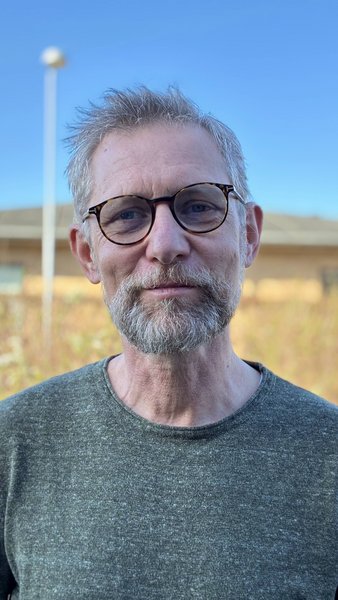
When Bo Vangsø Iversen talks about water, he is not only referring to what infiltrates the soil or flows through drainage pipes. He is talking about the water that connects fields with fjords, agriculture with the environment, and decisions with consequences. Water that moves, often invisibly, through the soil, shaping both landscapes and societies, and which, in combination with nutrients, has major implications for plant growth and for the surrounding aquatic environment.
It is a perspective sharpened through nearly three decades of research, and one that now defines his new role as Professor and Deputy Head of Education at the Department of Agroecology at Aarhus University.
A hole in the ground is a world opening up
His interest in soil emerged early on, not as an abstract concept, but in a very tangible way.
“I was fascinated by the fact that you could simply dig a hole and see a story unfold as you move down through the different soil horizons,” he explains. The colour, structure, and variation of the soil revealed how climate, vegetation, and time had left their marks.
Bo Vangsø Iversen holds a degree in geology from Aarhus University and a PhD in environmental engineering from Aalborg University. When he was employed in Foulum in 1996, then part of the Danish Institute of Agricultural Sciences (today AU Viborg), it was as part of an EU project on erosion. A job he applied for without knowing that it would mark the beginning of a long career working at the crossroads of natural science, agriculture, and society.
Water as the key
His research quickly led him deeper into the internal processes of soil. During his PhD studies, he focused on the hydraulic properties of soil: how water and air move through it, and what this means for the transport of nutrients and pesticides.
“If you don’t understand water transport, you don’t understand leaching,” he says.
It is a point that has followed him ever since. Over the years, he has played a central role in research on drainage systems, macropore transport, and the movement of water and substances from agricultural land, often in direct interaction with political agendas and environmental regulation. His work on constructed wetlands, compact filter systems, and other drainage mitigation measures has helped generate new knowledge on how to reduce pressure on the aquatic environment without abandoning agricultural production.
From research to landscape thinking
Today, Bo Vangsø Iversen approaches the landscape from a more holistic perspective. The question is no longer only how water moves, but how we can restore some of the buffer zones and natural systems that once existed in cultivated landscapes.
“How can we reintroduce wetlands, ponds, and natural delays in the water’s pathway, while still farming the land? That is one of the most interesting questions right now,” he says.
This is research that speaks directly to some of today’s major societal challenges: climate change, aquatic environments, drinking water, and land use. It requires both deep disciplinary expertise and a strong understanding of practice.
Education as a core mission
But research is only half of the story. Education is just as important. Since Aarhus University took over the former sector research institutions in 2007, Bo Vangsø Iversen has been deeply involved in teaching and educational development, as course coordinator, programme director, and member of study boards and education committees.
The relocation of educational programmes from Aarhus to Viborg in 2021 marked a milestone. A demanding process in which he has been closely involved, first with the bachelor’s programme in Plant and Food Science, and now with the development of a master’s programme in Plant and Soil Science, which will launch in 2027. At the same time, an international Bachelor of Engineering programme is also underway.
“We’re not there yet, but I believe it is possible to build attractive degree programmes and a study environment that makes it genuinely appealing to be a student in Viborg,” he says.
Representing the students
He sees his appointment as Deputy Head of Education as a clear signal.
“It shows that the department takes education seriously as a core mission,” he says.
His ambition is clear: to strengthen the quality of teaching, support lecturers, and, not least, represent the students’ interests at the management level.
“At every level, it’s important that we support students both academically and as people. If we treat them well, we also educate stronger graduates, people who can make a difference both within and beyond the university,” he says.
The future is about resilience
Looking back, Bo Vangsø Iversen’s career has been about movement: of water, of knowledge, and of people. Looking ahead, it is increasingly about resilience.
Both landscapes and educational systems face a future where change comes faster and solutions are rarely straightforward. He does not believe in fixed models, but in flexibility combined with strong academic foundations.
“We need to educate students who can handle this complexity,” he says.
That requires research that dares to ask difficult questions, and educational programmes that make room for both academic rigour and human development. Not to create perfect solutions, but to provide a stronger foundation for the choices that inevitably must be made.
Further information
Contact:
Professor and Vice Head of Education
Bo Vangsø Iversen
Department of Agroecology, Aarhus University
Tel.: +45 9350 8045
Email: bo.v.iversen@agro.au.dk