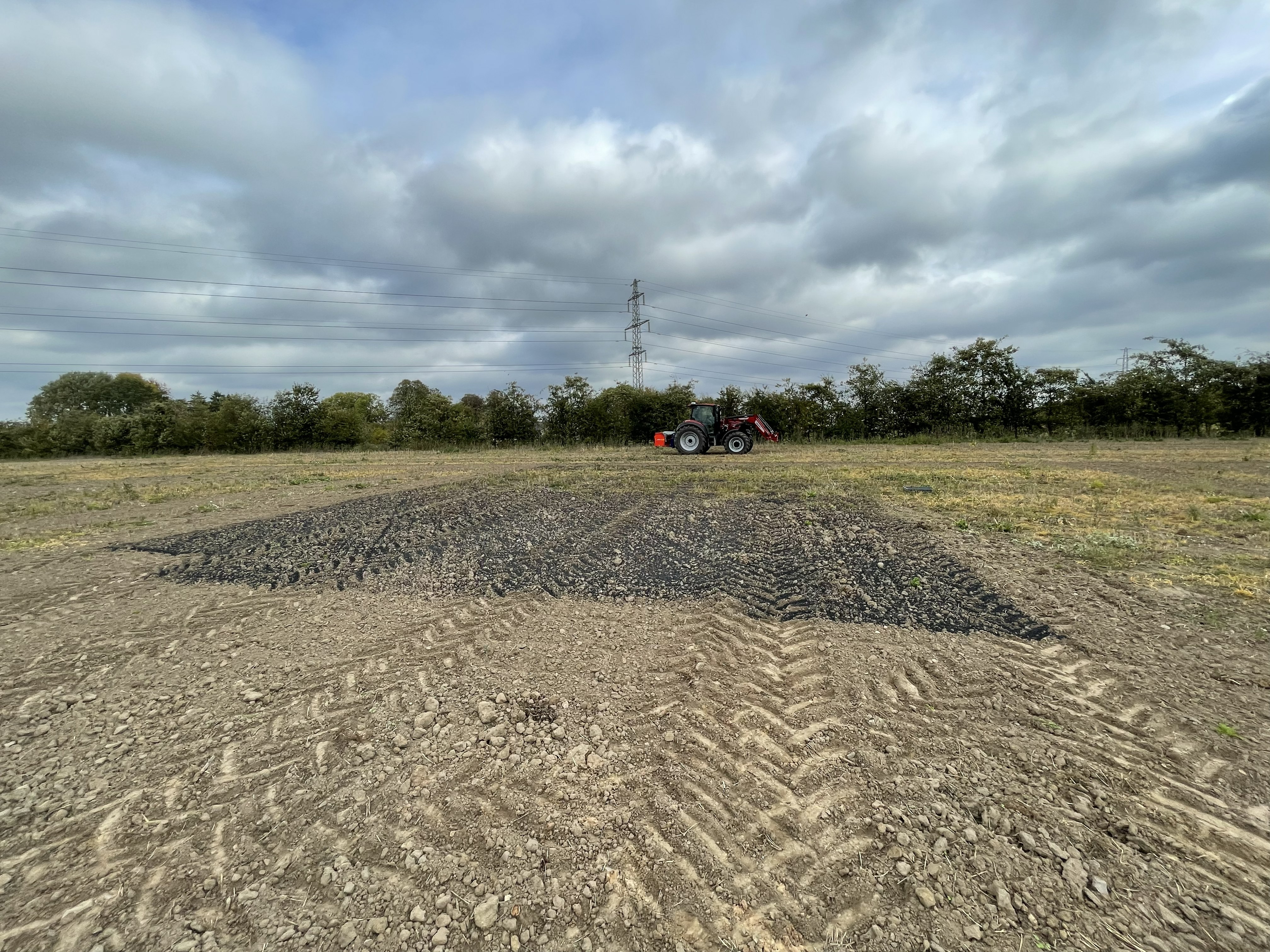
Højbakkegård is located on Zealand in Høje-Taastrup Municipality, where the Department of Plant and Environmental Sciences, University of Copenhagen, has access to 57 hectares, including the soil type JB6 (fine sandy clay loam).
The experimental field lies immediately west of Højbakkegård and is located at the southern end of a larger experimental field, where biochar is applied to 0.43 hectares. The area is cultivated according to local farming practice.
The experimental treatments include biochar from straw, biogas digestate fibres, sewage sludge and wood, as well as an untreated reference where no biochar is applied. The four different types of biochar are applied as a single dose based on either carbon content (biochar from biogas digestate fibres, straw and wood) or phosphorus content (biochar from sewage sludge). The treatments are laid out in plots of 18 x 15 meters, which allows for thorough investigations under realistic farming conditions, as well as the inclusion of sub-treatments in selected plots. A sub-treatment with reduced nitrogen fertilization rate was established in 2026 and another sub-treatment (straw incoporation) will be established in 2027.
Suction cups have been installed in all plots, allowing drainage water to be collected and analyzed for nitrate and other constituents.
The field trial has been initiated in the autumn of 2026.
You can read more about Højbakkegård here: https://plen.ku.dk/pfv/forsoegsgaarde/omfsg/

