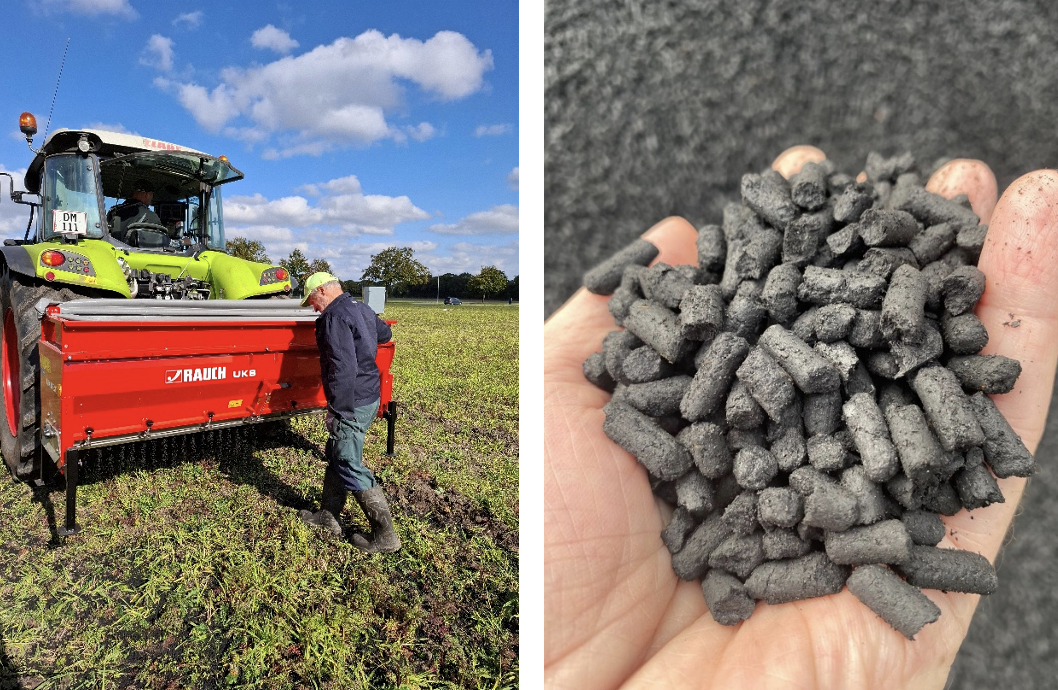
Askov Experimental Station (55°28'10.2"N 9°06'36.1"E, 64 meters above sea level).
Jyndevad Experimental Station (54°53'29.0"N 9°07'42.1"E, 14 m above sea level).
Foulumgård Experimental Station (56°27'00.2"N 9°32'25.4"E, 61 meters above sea level).
Zealand: Unresolved
The experiments were established in 2025 in Askov and Jyndevad. An additional treatment with wood-based biochar will be established in Jyndevad in 2026.
The experiments in Foulum and Zealand are planned to start in 2026.
The overall objective of Danish Biochar LTE is to investigate and document agronomic and environmental long-term effects of different biochar treatments under Danish field conditions. This includes effects on crop yield and quality, soil chemical, physical and biological properties, as well as nitrous oxide emission and leaching of nitrate. Leaching of potential biochar pollutants will also be investigated in targeted campaigns. In addition to the field experiments, lysimeter experiments will investigate leaching of biochar pollutants under extreme application rates to simulate leaching risks under biochar stockpiles. Other lysimeter experiments investigate phosphorous dynamics at different biochar treatments and yet another soil column experiment targets the biochar carbon stability using isotope-labeled biochar.
Askov: Sandy loam, Aric Haplic Luvisol, Ultic Hapludalf.
Jyndevad: Coarse sandy soil, Orthic Haplohumod
Foulum: Sandy loam soils. Mollic Luvisol
The main plot treatment is based on four types of biochar and two types of application rates. The four biochars are made from straw, biogas residue fibers (BRF), sewage sludge and wood.
Biochar from straw and BRF are applied at a low annual rate (1 ton of biochar-C/ha) and a high single rate (10 tons of biochar-C/ha).
Biochar from sewage sludge is applied at a high single rate (90 kg of biochar-P/ha).
Biochar from wood is applied at a high single rate (10 tons of biochar-C/ha).
The experimental design also holds options for subplot treatments, with straw incorporation currently implemented as a subplot treatment in Jyndevad.
A physical archive for soil, plant and water samples is located at the Askov Experimental Station. Soil samples for microbial analyses are archived at the department of Environmental Science, Aarhus University.


